
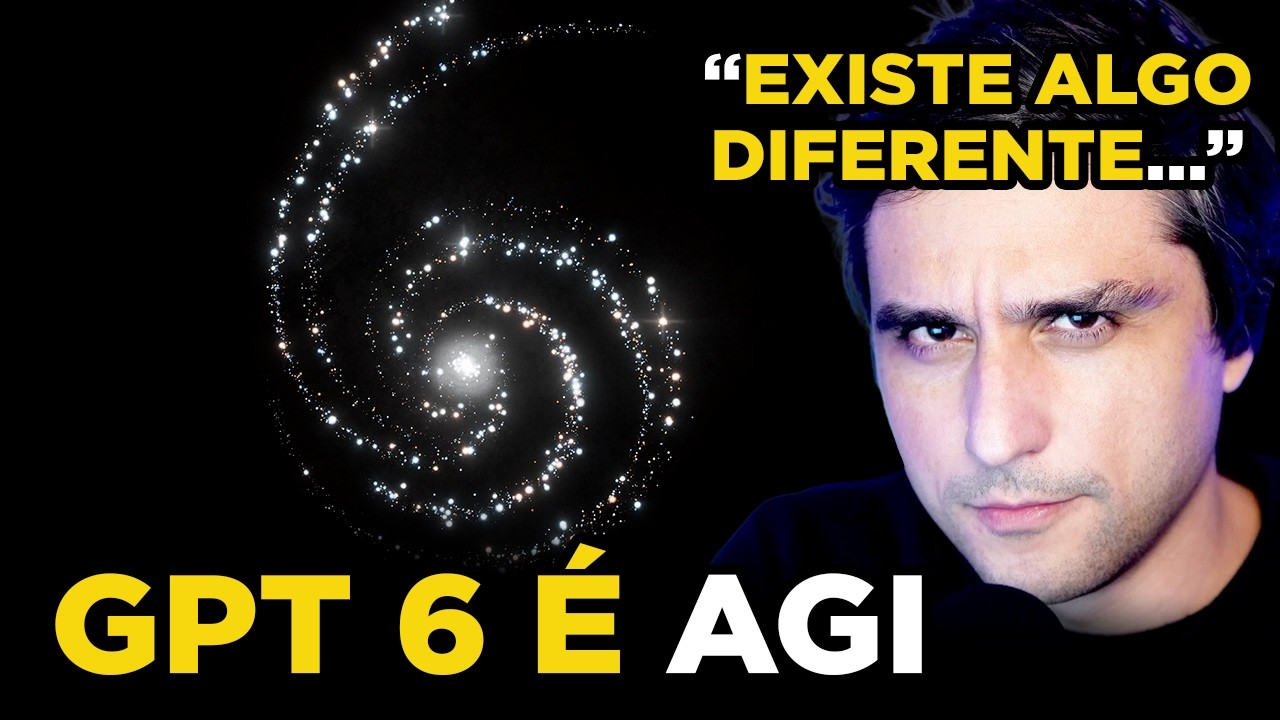

GPT-6 fez 99,9% neste Teste… Chegamos à AGI?
Resumo
Em uma frase
O GPT-6 Astra alcançou 99,9% em testes de AGI, levantando questões sobre se chegamos à inteligência artificial geral.
O GPT-6 é AGI?
Segundo Greg Brockman, cofundador da OpenAI, sim: ele acredita que estamos no era da AGI e que o GPT-6 Astra representa isso. No entanto, é importante ressaltar que há claramente um componente de marketing nessa afirmação, considerando a competição feroz com a Anthropic e empresas chinesas. O que torna a questão interessante é que o modelo realmente apresenta capacidades notáveis que desafiam a definição tradicional de inteligência artificial.
Resultados impressionantes em benchmarks
O resultado mais chocante é o desempenho no teste ARC-AGI 3, o mais avançado da série: o GPT-6 Astra alcançou 99,9% de acurácia. Para comparação, o GPT-5.6 Sol obteve apenas 7,8% e o Claude Opus 5 chegou a 30%. Esses testes de lógica são desafiadores porque exigem que a IA descubra as regras do jogo enquanto joga, algo que historicamente apenas humanos conseguem fazer bem.
Existe certa ceticismo legítimo: será que houve overfitting dos dados? A OpenAI provavelmente não teria publicado esses números se algo assim tivesse ocorrido, mas o resultado é tão excepcional que novos benchmarks precisarão ser criados para avaliar adequadamente esse nível de inteligência.
Capacidades de uso de computador
Uma das principais ênfases do lançamento é a habilidade do GPT-6 em manipular ferramentas e programas de computador. O modelo consegue:
-
Acessar sites e executar tarefas específicas
-
Criar conteúdo em diversos programas
-
Trabalhar com dashboards e ferramentas de produtividade
Embora a demonstração com Power BI tenha sido considerada menos relevante (a ferramenta está sendo descontinuada), a capacidade geral de uso de computador é genuinamente impressionante.
Criações de usuários com acesso antecipado
Pessoas que tiveram acesso antecipado ao modelo criaram coisas notáveis:
-
Um jogo 3D completo com gráficos avançados, onde o jogador pode construir uma aldeia, com múltiplos agentes de IA que se comunicam entre si
-
Slides e apresentações (embora o design não tenha sido particularmente sofisticado)
-
Reconstruções de ambientes em 3D usando Blender e Unreal Engine
Aplicações em design 3D e interior design
Um dos destaques mais impressionantes é a capacidade de trabalhar com modelos 3D. O modelo consegue:
-
Importar modelos do Blender
-
Usar Unreal Engine para criar ambientes completos baseados nesses modelos
-
Gerar vídeos interativos de navegação dentro de espaços
-
Criar PDFs com fotos dos cômodos e móveis
Vários usuários confirmaram que essa funcionalidade realmente funciona de forma impressionante, o que pode transformar significativamente o trabalho de designers de interiores.
Definições de termos importantes
-
IA: Inteligência Artificial comum
-
AGI: Inteligência Artificial Geral, tão competente quanto os melhores humanos na maioria das áreas de conhecimento
-
ASI: Inteligência Artificial Super, uma inteligência muito mais avançada que a humana
Contexto de competição
O GPT-6 representa o "trunfo" da OpenAI neste ano para vencer a Anthropic. Ambas as empresas estão em competição acirrada, com modelos muito similares. Agora, a expectativa é pelo próximo movimento da Anthropic, que pode lançar Claude 6 ou uma nova versão do Opus para superar o GPT-6.
Conclusão
Embora haja marketing envolvido no discurso sobre AGI, os resultados técnicos são genuinamente impressionantes. O modelo demonstra capacidades que vão muito além do que se esperava, especialmente em testes de lógica e raciocínio. A questão central permanece: isso é verdadeiramente AGI ou ainda é "apenas" um modelo muito bom que falta algumas características fundamentais para ser considerado uma inteligência geral de verdade?
Chat
Entre para conversar com o vídeo.
EntrarPrincipais Pontos
A OpenAI lançou o GPT-6, codinome Astra, em 3 de setembro.
O GPT-6 Astra atingiu 99,9% de acurácia no benchmark ARC-AGI 3, o teste mais avançado da série.
O GPT-5.6 Sol (modelo anterior da OpenAI) alcançou apenas 7,8% no mesmo teste, e o Claude Opus 5 da Anthropic chegou a 30%.
Greg Brockman, cofundador da OpenAI, afirmou acreditar que já estamos na era da AGI e que o GPT-6 Astra representa esse marco.
O GPT-6 tem forte ênfase em uso de computador (computer use), manipulando sites, programas e dashboards.
O modelo é capaz de importar modelos do Blender, usar Unreal Engine e gerar vídeos interativos de ambientes em 3D, útil para design de interiores.
Usuários com acesso antecipado criaram um jogo 3D completo com múltiplos agentes de IA que se comunicam entre si.
GPT-6 Astra é apresentado como mais barato que o GPT Fable 5.1 para determinadas tarefas, custando metade ou um terço do preço.
Definições apresentadas: IA (inteligência artificial comum), AGI (inteligência geral tão boa quanto os melhores humanos na maioria das áreas) e ASI (superinteligência artificial, muito além da humana).
Há ceticismo sobre possível overfitting nos resultados do ARC-AGI 3, mas acredita-se que a OpenAI não divulgaria números falsos.
O lançamento é visto como o trunfo da OpenAI para superar a Anthropic, com expectativa de resposta via Claude 6 ou novo Opus.
Mindmap
Palavras-chaves
Transcrição
Well, let's talk about some technology
news that happened in the last few days
. Finally, GPT-6 has been released.
OpenAI launched the model codenamed
Astra, which is GPT-6, and it's truly
quite impressive because the model
manages to be better than Anthropic's
models, so the competition is really
heating up between the two companies.
And there are also a lot of people
saying that perhaps this OpenAI model
is finally an AGI, because there are
some market benchmarks that this model
managed to surpass, which is an
impressive feat. Let's talk a bit more
then about GPT-6, some interesting
things people are creating with this
model, and let's see if this model
really is an AGI. Why are people
talking about this? Well, we'll talk
about this and other tech topics in
this video. So, on September 3rd,
OpenAI released GPT-6, and the
presentation of this model was really
cool, right? I don't know, they put it
on their website looking like a galaxy
with the number six. They really did a
great job with the marketing for this
new model. And look, it had been a few
weeks, even months, that OpenAI had
been dropping some teasers about the
name Astra, suggesting it would be a
new model. And now it has become clear
that Astra was, in fact, GPT-6. And
honestly, if we stop to think about it,
it's crazy, because it wasn't long ago
that we were here in these videos
discussing, I don't know, the launch of
GPT-4 and just kind of fantasizing
about when OpenAI would release GPT-6
and how advanced GPT-6 would be
compared to GPT-4 or other previous
models. So, I don't know, it's
impressive. I don't know if time is
passing quickly or if the models are
evolving even faster. Maybe that's the
point. But hey, there are some very
interesting things, right? For example,
OpenAI released this video here showing
, I don't know, this new model in
action. So you can, you know, talk to
the model and ask for things. And what
is clear in this video, and what they
emphasize here in this post, is that
GPT-6 is very good at using the
computer, at computer use. So it can
manipulate various tools, various
programs, and do what you want. And in
all these tests they showed here, this
is very clear, right? People go there,
ask the AI to do something, the AI
accesses a site, creates something, or
works in a program. So that is what
they are focusing on, what GPT6 is very
good at. And it's interesting because,
well, we know there is a very fierce
competition between OpenAI and
Anthropic, obviously. And when we look
at the benchmarks here, the comparison
between the models, it is very clear
that GPT Astra either surpasses
OpenAI’s Fable 5, which is now in
version 5.1, also recently released.
And even if it doesn’t quite surpass
or isn’t better than Fable 5, at
least what they emphasized here is that
GPT6 costs much less. So, for some
tasks where using Fable 5.1 costs a
fortune, Astra would cost half or a
third of that. And, well, there are
some things they actually had this
model do that I found impressive, and
we will see them here. And there were
some things I thought were a bit
irrelevant. Like, I don’t know, for
example: they put a video here showing
this new model manipulating Power BI,
which is Microsoft’s dashboard tool,
showing that the model can move the
mouse and create new charts within
Power BI. But I thought this was
pointless because, well, this is a
program that is sort of being
discontinued, right? Nobody really
wants to use Power BI anymore. No data
analyst, no one who, I don’t know,
has to create dashboards, is using AI
to create Power BI reports. People are
trying to create new dashboards using
AI, but outside of this Microsoft
system, right? So I thought this part
was a bit pointless. Something they
showed here that I was like, yeah,
maybe it’s not that interesting, is
that, well, the new model can create
slides, right? But looking at these
slides here, I don’t know, I didn't
think it was a big deal. Of course
it’s interesting because it brings
the information, and the information
here is most likely correct. But in
terms of design, I don’t know, I
didn't think it was much, to be honest.
But many people got early access to
GPT6 and started using the model in
recent weeks; and now that it has been
released, these people have started
posting what they created recently. And
there are some very interesting things.
So, I don't know, for example, this guy
posted on Twitter that he used Astra
over the last few days to build a game,
basically a game with 3D graphics, I
don't know, quite advanced. And it's a
game where you can kind of create a
village, it's a crazy thing. But, of
course, the game has some limitations,
it isn't finished yet, but it's very
impressive what, I don't know, if you
just let Astra work, what it can
achieve with just a few prompts? This
here is something truly impressive. He
let the thing run there, creating this,
and the AI simply created the game. But
it's not a common game, it's actually a
game where there are several AI agents
inside that can talk to each other,
which is something really impressive,
right? And another very impressive
thing, which is something OpenAI itself
published in the official GPT6 post
regarding interior design, especially
using Unreal Engine tools and also
Blender. So, for example, you can
upload a Blender model, a 3D model, and
Astra itself will be able to use Unreal
Engine and create an entire view, an
environment using the Blender model,
and create a video of someone
navigating inside an apartment, a house
, from the 3D model that was created.
Man, this is very impressive. And then
create an entire PDF with photos of the
rooms and the furniture. This is
something I really found impressive.
And several people posted on Twitter
that they had early access to GPT6 and
tested this functionality of
reconstructing these 3D things coming
from Blender. And look at this, it's
really impressive, right? How GPT6 is
managing to manipulate these 3D images
and create these visuals and animations
. Anyway, this can really change the
lives of interior designers a lot. I
don't know, there are a lot of people
commenting on this, right? Commenting
on this OpenAI video and showing how
this was done from the floor plan that
GPT Astra managed to create later in
Blender, the 3D visualization, and even
the video of the environment that was
created, which is even interactive; you
can manipulate the objects there. Man,
this is really cool. But, for me, the
most interesting thing about the GPT6
launch was an analysis they published
in the official OpenAI post, which is
something that might have gone
unnoticed by some people, but it is
extremely important. Well, if we look
here at OpenAI's post and search for
AGI, we come across this benchmark here
, this analysis that shows how GPT6
Astra. performed in relation to the ARC
AGI 3, 2, and 1 benchmarks. And the ARC
AGI is this benchmark here, which I've
also mentioned in some videos, where
there are some tests that AIs are
subjected to, which are logic tests
that usually only human beings can
solve, because it's a kind of game that
you have to manage to win, but you only
discover the rules of the game while
playing it. So that requires logic
there for you to be able to understand
the thing. It's not a game where you
could know beforehand what you have to
do. And look, the most absurd thing is
that GPT6 Astra reached 99.9%in ARC AGI
3, which is the most advanced ARC test.
This is impressive because the previous
model, GPT 5.6 Sol, reached 7.8%and
Claude Opus 5 had reached 30%in this
thing. Of course, anything that reaches
99.9%accuracy, we are a little
skeptical, right? Did they really
perform the test correctly? Or is there
some overfitting of the data happening
there? I don't know, maybe GPT6 was
trained on the data from this test and
that's why it got everything right. But
look, I think OpenAI wouldn't have
released this if something like that
had happened, right? So everything
indicates that this new model really
has something special. It is one of the
most intelligent models and the closest
to an AGI that has ever been created so
far. And this test here makes that very
clear. And so, this is interesting
because some news sites publishing
about the launch of this new model
touched exactly on this point, that
OpenAI's new model has entered the AGI
era. The Verge published about this and
Wired also published exactly the same
thing, that GPT6 Astra is here and that
OpenAI thinks we may have entered the
era of AGI. So, what would an AGI, an
Artificial General Intelligence, be, an
artificial intelligence that would be
as good at most tasks as normal human
beings? an AI that would be better than
us at any type of task, basically in
any field of knowledge. Of course, an
AI, you know, like GPT-6, can't tie a
shoelace because it’s just a
theoretical intellectual AI, but in all
other fields of knowledge and even
logic, this model is already highly
advanced and can be superior to or as
good as the best humans. And so,
recently, Greg Brockman, who is one of
the founders of OpenAI, gave an
interview where he commented a bit on
this subject. He said that, if we
manage to progress over the coming
years and look back, we might ask
ourselves, you know, when was AGI
actually created? And he believes, Greg
believes, that it would be around this
time, and that it might be about this
model that's being released. And later
in the interview, well, he said that
personally he believes we are there. He
says he doesn't think it's irrational
to think that we are already in the era
of AGI, that we have managed to build
an artificial intelligence that is as
good as the best humans in the vast
majority of areas of knowledge. And
it's important to make the distinction,
you know, between the terms. So we
would have AI, which is, you know,
artificial intelligence, and AGI, which
is artificial general intelligence. So,
it would be an intelligence very
similar, very compatible with human
intelligence in most fields of
knowledge. And there would also be ASI,
artificial super intelligence, which
would really be an expanded
intelligence or one much more advanced
than ours. So, GPT-6 Astra would be an
AGI, according to Greg Brockman here.
But of course, you know, we know that
this could be a big marketing stunt,
because we know there's competition
there with both Anthropic and Chinese
companies, and that the models are very
similar and are competing head-to-head.
So for him to say that their model, GPT
-6, is an AGI, there is marketing
behind it, we know that. But at the
same time, I was very shocked by the
ARC-AGI results, showing that this
model managed to reach 99.9%, which
means they will have to create a new
benchmark to be able to evaluate this
model, to be able to test the
intelligence of this AI regarding AGI.
And you can see that the model is
really very good at building many
things, whether in the model's ability
to work well on a computer and
manipulate various programs and
interpret that, using 3D models to
create incredible scenarios, and not to
mention that the model is extremely
advanced in programming. So, anyway, I
think this was the ace up OpenAI's
sleeve this year to manage to beat
Anthropic. And now we'll have to wait
to see what Anthropic will do, when
they will launch Claude 6 or Opus 6 or
a new Mythos model that will leave GPT-
6 behind. But for now, well, OpenAI is
winning. But what is your opinion on
this subject? Do you really think GPT-6
Astra is AGI? Does it have the
necessary characteristics to say that,
well, it is a model that is actually
smarter or as smart as a human being or
just a very good model, but one that
still lacks those characteristics? And
that, deep down, what they are doing
here with the launch of this thing is
just a marketing stunt, until the
Chinese models come along and put an
end to all of this. Write down here in
the comments. Let's discuss this
subject a little more.